
Endotoxins in medical devices are an ongoing concern for patient safety efforts, but they’ve been challenging microbiologists since the 19th century.1 These tiny toxins are a byproduct of gram-negative bacteria, formed when the cells die and undergo autolysis.1 To address this ongoing concern, Poriferous manufactures Su·Por® implants in-house and batch-tests them for bacterial endotoxin levels as part of its commitment to quality and patient safety.
All endotoxins are pyrogens, although not all pyrogens are endotoxins. Endotoxins can induce strong inflammatory reactions and are associated with fever and generalized bodily reactions, including chills, aches, blood pressure and circulatory changes. Significant exposure to them can prove fatal.1,2
Many metals and polymers used in biomaterials also have a high affinity for endotoxins2 which is why the FDA has called for endotoxin testing for biological products, drugs, and devices since the 1970s.1
Endotoxin Limits for Implanted Devices
Testing for endotoxins is particularly important for permanently and subcutaneously implanted devices3 including biocompatible, porous polyethylene SuᐧPor® implants. The FDA notes pyrogenicity testing safeguards patients against reactions caused by gram-negative bacterial endotoxins or other pyrogens4. This makes endotoxin control an important safety measure.
Per the FDA, medical-device endotoxin limits depend on intended use and what the device contacts.3 To guide manufacturers, the FDA has developed testing recommendations and acceptance criteria across biologic products.
As the FDA lists implants among devices that should meet pyrogen-limit specifications, they recommend that manufacturers identify the testing method, limit, supporting rationale, and whether testing will occur on every batch or under a sampling plan.4
Their guidelines advise that sampling should consider potential contamination in raw materials, in-process materials, and finished products, as well as manufacturing conditions, hold times, endotoxin-removal steps, and finished-product specifications.4
Acceptable endotoxin limits under FDA guidelines are 0.5 EU/mL or 20 EU/device for cardiovascular or lymphatic-system contact and 0.06 EU/mL or 2.15 EU/device for cerebrospinal-fluid contact.3
Accounting for the Uncontrollable
The FDA has long recognized the limitations of controlling endotoxins, recommending that manufacturers describe their results as “non-pyrogenic” or “meets pyrogen limit specifications” instead of “pyrogen-free” unless complete removal of pyrogens has been established.4 The agency further recognizes that pyrogen testing alone cannot be used entirely for detection and characterization of microbial endotoxins.1
As sterilization and sterility testing can’t establish that implants are within acceptable pyrogen limits alone, Poriferous ensures that every product cycle for SuᐧPor implants is tested for endotoxins.5
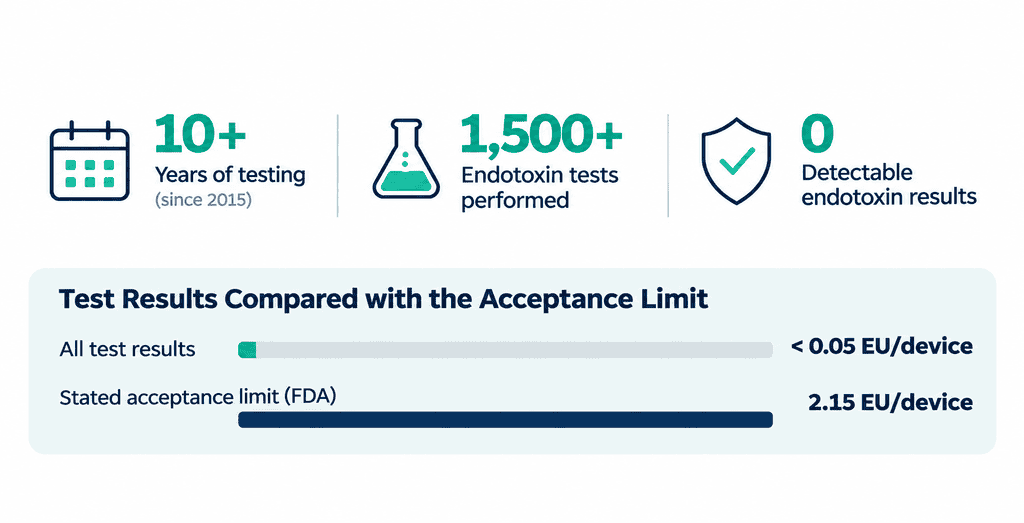
Since 2015, Poriferous has conducted more than 1,500 endotoxin tests on Su·Por® implants, with no detectable endotoxin levels recorded. All test results have been below the method’s detection limit of 0.05 EU/device, compared with the stated acceptance limit of 2.15 EU/device. These results reflect more than a decade of consistent testing as part of Poriferous’ commitment to quality and patient safety.5
Over a Decade of Su·Por® Endotoxin Testing
Additionally, post-market surveillance data for Su·Por® implants demonstrates an infection rate of under 0.5%.⁵
To learn more about Poriferous’ endotoxin testing protocols and explore our range of craniomaxillofacial implants, please visit https://poriferous.com/flipbook-catalog/.
Sources
- U.S. Food and Drug Administration. “Bacterial Endotoxins/Pyrogens.” Inspection Technical Guide No. 40. March 20, 1985. https://www.fda.gov/inspections-compliance-enforcement-and-criminal-investigations/inspection-technical-guides/pyrogens-still-danger
- Lieder, R., Petersen P., et al. “Endotoxins—the Invisible Companion in Biomaterials Research.” Tissue Engineering Part B: Reviews 19, no. 5 (2013): 391–402. https://doi.org/10.1089/ten.TEB.2012.0636
- U.S. Food and Drug Administration. “Pyrogen and Endotoxins Testing: Questions and Answers.” Guidance for Industry. March 18, 2026. https://www.fda.gov/media/83477/download
- U.S. Food and Drug Administration. Submission and Review of Sterility Information in Premarket Notification (510(k)) Submissions for Devices Labeled as Sterile. Updated January 2024. https://www.fda.gov/inspections-compliance-enforcement-and-criminal-investigations/inspection-technical-guides/bacterial-endotoxinspyrogens
- Internal data on file: Poriferous.